Monday, 9 July 2007

Take A Ride

One of my co-workers feels that this blog has been a bit down on India. So he told me to take a ride…on the Delhi Metro.

It was amazing. In case you haven’t heard, the Delhi Metro is a screaming success story. There is limited service now but there will be more than 270 kilometers of rail connecting the city by the time the project is finished. Not only is the construction on-time and under-budget, but I actually enjoyed my ride on the Yellow Line. The station was clean, the maps were clear and the cars were air-conditioned.

More importantly, the Delhi Metro is being cited as an example of business and government working together to make things happen. And it is inspiring action across the country. The genius behind the metro is a 74-year-old yoga-loving engineer and railways expert, Elattuvalapil Sreedharan, who has demonstrated that he can get it done by ably managing his cash, staff and process. The construction has been environmentally friendly and they are ensuring handicap accessibility. But what is most impressive is that he is doing all this construction under a bustling city! Click here for an interesting article on Elattuvalapil.

Not that there hasn’t been controversy. Some neighborhoods are concerned about having elevated tracks and current ridership numbers are lower than expected. People are still riding those crazy buses! But, overall, the process has been a smooth ride (bad pun intended).

Unlike the harried experiences of scooters, rickshaws and buses, I arrived cool, calm and collected at my destination after my Metro ride. And all for less than 20 cents. Maybe we could convince Elattuvalapil to come to New York to help with the Second Avenue line.

Sunday, 8 July 2007

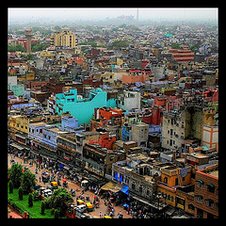
Exploring Old Delhi


John and I spent a day exploring Old Delhi this weekend. What a contrast from what we have seen so far. We first made our way through the maze of markets, sneaking through spindling rows of stalls, selling everything from light fixtures to spices to prescription drugs. You could spend hours in this labyrinth, trying to absorb the sights and sounds. My favorite players in this symphony of chaos were the chai boys, scurrying about delivering cups of tea.


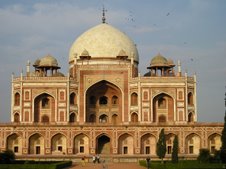
We then explored Delhi’s Red Fort, a palace and fortress built by Shah Jahan, another Mughal emperor (see photo above). It was a fantastic monument and I realized again how complicated Indian history is. So many people from such different backgrounds, religions and cultures call this place home. A museum within the fort had an exhibit on the struggle for independence; it revealed the story of Nehru, Gandhi and the others who fought courageously to call their country their own.


We headed next to Jama Masjid, Delhi’s famous mosque which can hold more than 25,000 people in its courtyard (see photo above). On the walk, we cut through a “park” which has been transformed into informal housing. It was basically a shanty-town. It was one of the most difficult things I have seen so far in India. I did not take pictures – it was so dirty, poor and depressing that doing so felt exploitative. Everyone was living in absolute filth, including small children forced to entertain themselves by begging, searching for food or throwing rocks at stray puppies. The most shocking thing, though, was an infant sleeping in a bag. Hanging off a railing in a piece of cloth that looked like a plastic bag, a tiny infant was crunched into a ball. When I first looked, I thought the baby was dead and was being thrown away.

As I climbed the steps of the mosque, I wondered how we, as human society, have failed these communities. At the top, I looked out over the city and felt angry at our institutions - governments, businesses, NGOs, churches, schools, hospitals and more - because we have not figured out a way to meet the basic needs of every child born: all deserve food, water, shelter, medical care, safety and love.

Friday, 6 July 2007

A Purple Cow at Drishtee


Drishtee is a remarkable organization. While the first priority is the village communities that we work with, our founders have also established relationships with powerful business and social leaders across the globe. And these friendships have benefits.

This week, marketing maven Seth Godin visited Drishtee. He is a Stanford Business School grad who has published several business bestsellers including Purple Cow, Permission Marketing and All Marketers are Liars. His most recent book is The Dip. He normally commands thousands of dollars in speaking fees but he is such an avid supporter of Acumen and Drishtee that he came to us.

Seth spent several hours at the head office before heading out to the village kiosks. He recognized Drishtee for its vision, innovation and courage in taking on the challenges of working in rural India. At the same time, he asked tough questions and challenged Drishtee to be extraordinary. To make a difference, we have to be great.

Having Seth here made me realize that people are almost always an organization’s most critical assets. As we develop models that use markets to create social value, we have to enrich the human capital within these organizations, especially if we want them to grow rapidly. It sounds strange but we need to focus more on middle management; as these social businesses grow, lots of less-prominent leaders need to be trained and supported to ensure ultimate success.

For another great article on Drishtee and the Acumen Fund, click here.

Thursday, 5 July 2007

Shotguns and Staches


There is nothing like a double-barreled shotgun to spice up the morning commute. On my walk to work, the man next to me was carrying a rifle. I assume that he is a security guard as they are everywhere in India. At offices, ATMs, restaurants, malls, stores and government offices. The only place I have not seen guards is bathrooms. Funny, as I have found toilet paper to be a rather valuable commodity here.

Like South Africa and other countries I have visited, private security services is big business. Click here to find out more. However, unlike the other countries, guards seem to carry double-barreled shotguns as often as semi-automatic weapons. I can't decide whether this makes me feel more or less safe. However, I am more disconcerted by the protocol of toting the gun around while off-duty. I keep imagining some guy bustling through Times Square on his way to work with a shotgun on his back while all the tourists are freaking out. What a scene.

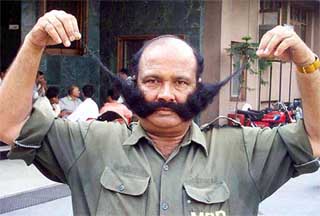
By the way, the guy in the picture was NOT the security guard I saw this morning. I just liked the photo. This is Kewal Krishnan, another security guard who was famous for his 15.7 inch moustache. His stache may be more intimidating than his shotgun.

Wednesday, 4 July 2007

Dynamic David and Awesome Acumen


I am bummed to report that my colleague / boss, David Lehr (pictured above), will be returning to the U.S. soon. David has spent the last 8 months with Drishtee as part of the Acumen Fund Fellows Program, which places individuals with social enterprises all over the globe.

What is Acumen Fund? Acumen is a unique organization in NYC that was founded by Jacqueline Novogratz (also a Stanford Business School grad!). Acumen is a “
non-profit venture fund that uses entrepreneurial approaches to solve the problems of global poverty.” Simply put, they want to use business to end poverty. Acumen provides direct investment as well as business support (people like David) to budding social enterprises from Nairobi to Noida. For more on Acumen’s investment in Drishtee, click here.

This business doing good stuff is exciting, especially as I watch it happening here in India. Though I am a bit wary of big business, markets are being used to get good and services to communities that would not otherwise have access. Even the potential for profits makes everyone pay more attention. Like successful businesses, these approaches should be sustainable over time, thereby encouraging long-term economic development within communities. Of course, there are complications, especially because businesses tend to have a lot more power than the poor. Social entrepreneurs are trying to strike the right balance between making a profit and having a positive impact.

In addition to its noble pursuit, Acumen has attracted great people. Consider David’s story. After a few successful years in Silicon Valley, David made a dramatic career switch. Realizing that technology could be used in innovative ways to encourage development, he stepped off the fast track to work in social enterprise and international development. Like the other Acumen Fellows, he has spent the last year helping Drishtee develop its business and increase its impact. For more on David, check out this video interview. As for life after Drishtee, David is still figuring out what he will do next. Whatever happens, he is confident he will remain in this field because he, like me, believes that it has tremendous potential.

Tuesday, 3 July 2007

Monsoon Season


Monsoon season is here. After hours of endless sun, the sky has broken and the rains have come. Luckily, we are spared from constant downpour here in Delhi. Instead, there are occasional bursts that drench everyone for fifteen minutes and then subside. Everyone seeks shelter under some form of plastic but, generally, everything gets wet. The positive side is that it all feels a bit cleaner and cooler afterwards.

We have it better than the rest of India. There is extreme flooding in Mumbai, Kolkata and other areas in the South. This picture was taken yesterday in Kolkata. There have been hundreds of deaths and extensive damage. And, for the most part, those who are most affected are least prepared to recover. More on the monsoon to come...

Sunday, 1 July 2007

The Ladies Compartment

No, I was not on this train. But you gotta love this photo. And you may notice that you do not see a lot of women. They are probably sitting in the "Ladies Compartment." Let me explain further.

On Saturday, my new roommate, John and I ventured into Delhi for the day. John is a fellow Drishtee intern and business school student who is equally clueless about India (I mean this in the best way John!). We make a great pair. Anyway, we decide to take one of the buses, which generally barrel through town at ungodly speeds, blasting their horns while people hang precariously out of the sides. No signage indicates where a bus stop is or where a bus is going but we found a crowd waiting on the street. Sure enough, several buses arrived and we found a ride to Delhi. However, the driver started arguing with a group on the street so we promptly piled off the bus and onto another bus. Then someone yelled at us to take another bus. We unloaded and loaded again.

As John and I squished in the back, I began settling in for a warm, cozy ride. Then someone motioned to me to come forward. Climbing over tangled limbs, I made my way to the "Ladies Compartment," a sectioned-off area in the front of the bus. It was quite remarkable. I mean, it was still hot and dirty but there were decorations and, more importantly, seats for all. And the women all smiled at me. It felt much friendlier than the back of the bus.

Apparently, this is not unusual in India. On many buses and trains, there are separate seats or compartments for women. While I enjoyed the ride, I also struggled with the fairness of the situation. Why should John have to stand but I get to sit? Or, more compellingly, why should an older Indian man have to stand while I sit?

As a feminist, I am unsure how I feel about this separation of areas, especially in a society where women are not always considered equal to men. It was too hot and I felt too uncomfortable to protest so I sat in the Ladies Compartment. I also understand that there are safety reasons in certain situations but I felt completely safe in the back of the bus. Ultimately, I was left wondering about this custom - is it chivalry or chauvinism? Or a combination of both?