Have you ever raked leaves in a swirling wind storm? Me neither. It sounds miserable. This occupied my thoughts while walking to work yesterday. It was an unusually cold and windy day here in DC and I was intrigued by a woman who was working outside one of the embassies near Dupont Circle. She was valiantly sweeping the sidewalks but seemed to be losing the war with the evil gusts. Everytime she moved a leaf into a pile, another was lifted and dispersed.
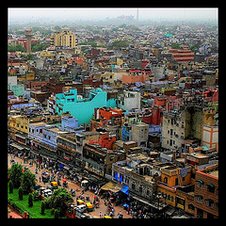
I became frustrated watching her. It reminded me of the women in India who would sweep the streets. Bent over awkwardly, they steadily pushed around their half-sized, homemade brooms. Even after hours of this, the dirt never seemed to go anywhere and the streets no cleaner. I saw this practice all over India, even on dirt roads. To me, it represented utter futility.
Throughout the day, I found myself wondering what it was like to be one of these women. I struggled to imagine how I would deal with that type of job. It would make me crazy. I felt grateful for mine. Yet, as I left the non-descript office building where I had spent all day inside, dressed in business casual, sitting in a cube, typing away on a computer – I wondered if anyone was observing me and thinking that I was the crazy one. That my job would frustrate them and make them nuts. They would hate being cooped up inside and dealing with office issues, whether bureaucracy or a broken computer. Which begs the question - is it more exciting to battle the wind and dust or powerpoint and email?
Thursday, 20 November 2008


Tuesday, 18 November 2008
Finders Keepers, Givers Weepers
I recently found a five dollar bill outside of my apartment. Instinctively, I picked it up. It was only after I got inside that I realized that I had no idea what to do with it. Should I try to locate the owner? No, it was a small denomination and I found it in a public place. It would be almost impossible to get it back to its original owner.
So what should I do with it? I placed the crumpled character on my table because it felt uncomfortable to put it in my wallet. Somehow that would mean that it was mine. And though I wanted it, I did not need it.
After a night’s rest, I decided to give the five dollar bill away. I imagined the possibilities. Maybe I would be generous with a tip for my coffee guy. Or I could leave it in a conspicuous location where someone else would pick it up. If they needed it, they would use it. If not, maybe they too would pass it on.
Stuffing the bill in an outside pocket of my bag (not in my wallet!), I headed to work. Sure enough, I encountered a homeless woman in a wheelchair asking for money outside my metro station. With an awkward aha! moment, I yanked the bill out and gave it to her. All I remember was her face. It was an unforgettable look of simple, grateful surprise.
Which made me even more uncomfortable. Was she surprised because people rarely offer her more than a dollar? Was she grateful because she could use the money to meet her basic needs? Of course, I imagined her using it to buy fruits and vegetables rather than booze or drugs. Or was this simply the look that she gives anyone that donates?
I don’t know. All I know is that this incident has me thinking about homelessness. I have a graduate education, I spent six years working in social services and I have traveled around the world. Yet I can’t figure out what the right thing to do is. You can argue that they are adults who make choices. But I can’t imagine sitting out there in the freezing cold, begging for your survival. I want to be empathetic. Still, I usually end up looking the other way, unless I have someone else’s five dollars to give.
Somehow this whole incident left me more conflicted than when I started. So please watch your money. I really don’t want to come across another orphaned bill. Finding a foster home for it is way too emotional.
So what should I do with it? I placed the crumpled character on my table because it felt uncomfortable to put it in my wallet. Somehow that would mean that it was mine. And though I wanted it, I did not need it.
After a night’s rest, I decided to give the five dollar bill away. I imagined the possibilities. Maybe I would be generous with a tip for my coffee guy. Or I could leave it in a conspicuous location where someone else would pick it up. If they needed it, they would use it. If not, maybe they too would pass it on.
Stuffing the bill in an outside pocket of my bag (not in my wallet!), I headed to work. Sure enough, I encountered a homeless woman in a wheelchair asking for money outside my metro station. With an awkward aha! moment, I yanked the bill out and gave it to her. All I remember was her face. It was an unforgettable look of simple, grateful surprise.
Which made me even more uncomfortable. Was she surprised because people rarely offer her more than a dollar? Was she grateful because she could use the money to meet her basic needs? Of course, I imagined her using it to buy fruits and vegetables rather than booze or drugs. Or was this simply the look that she gives anyone that donates?
I don’t know. All I know is that this incident has me thinking about homelessness. I have a graduate education, I spent six years working in social services and I have traveled around the world. Yet I can’t figure out what the right thing to do is. You can argue that they are adults who make choices. But I can’t imagine sitting out there in the freezing cold, begging for your survival. I want to be empathetic. Still, I usually end up looking the other way, unless I have someone else’s five dollars to give.
Somehow this whole incident left me more conflicted than when I started. So please watch your money. I really don’t want to come across another orphaned bill. Finding a foster home for it is way too emotional.
Saturday, 15 November 2008
Low Annual Fee
I recently signed up for a Southwest Airlines credit card. I fell for the sweet advertisement in the in-flight magazine. What can I say – I was a captive audience for three hours on a flight from Austin to Baltimore. To be fair, I also really enjoyed my flight and wanted to build up miles on Southwest so I would fly it more. The best part was the flight attendant, who got on the loud speaker and sang a little ditty when we arrived late. It was silly, irreverent and the most human response to a flight delay that I have experienced.
This all changed when I got the credit card a week ago and was totally stunned by a $60 annual fee.
I found the original in-flight advertisement and re-read it. Yes, it did indicate that there was a low annual fee. But they never mentioned exactly how much it was. How can you sell a product without telling someone the price? Instead, we are expected to guess at the definition of a low fee. Call me old-fashioned (or naïve) but I do not believe that $60 is a low fee.
Most of this is my fault. I should have been more skeptical. Still, I was depressed by Southwest’s response to my complaints. They blamed it all on Chase Bank (the card sponsor), explaining that they did not control Chase’s language in their advertisements. But my guess is that Southwest receives a pretty penny for that advertisement (which features the Southwest logo as prominently as the Chase one). They also probably get something out of the credit card deal with Chase.
I don’t know why this makes me so sad and angry. Coming off two years of business school, I should be familiar with this stuff. I blame the singing flight attendant. I was so touched by her actions that I started to care. I just can’t believe that she would be okay with this.
This all changed when I got the credit card a week ago and was totally stunned by a $60 annual fee.
I found the original in-flight advertisement and re-read it. Yes, it did indicate that there was a low annual fee. But they never mentioned exactly how much it was. How can you sell a product without telling someone the price? Instead, we are expected to guess at the definition of a low fee. Call me old-fashioned (or naïve) but I do not believe that $60 is a low fee.
Most of this is my fault. I should have been more skeptical. Still, I was depressed by Southwest’s response to my complaints. They blamed it all on Chase Bank (the card sponsor), explaining that they did not control Chase’s language in their advertisements. But my guess is that Southwest receives a pretty penny for that advertisement (which features the Southwest logo as prominently as the Chase one). They also probably get something out of the credit card deal with Chase.
I don’t know why this makes me so sad and angry. Coming off two years of business school, I should be familiar with this stuff. I blame the singing flight attendant. I was so touched by her actions that I started to care. I just can’t believe that she would be okay with this.
Friday, 14 November 2008
Local News
My parents have lived in the same house in the same town for more than 30 years. They have subscribed to our local newspaper during this entire time. You could say that they are loyal customers. But they are even more loyal Democrats. I think that they would only vote for a Republican if their children’s lives depended on it. Thus, they were beside themselves when their local paper, which has represented a progressive community for hundreds of years, endorsed John McCain.
I asked my mom whether they would cancel their subscription. She looked at me as though I had horns. Or worse, I had turned into a Republican. She said that they needed to know what was going on in their community. I tried to make an analogy: imagine the publisher of the newspaper pushing cigarettes on ten year olds but too no avail. They felt that strongly about staying connected to their community.
They also love the short paper format. The big city papers with their 30 plus page count are tough to get through in any reasonable amount of time in the morning. You have to get up at 5 am to get through everything. They truly appreciate the short, succinct and clear format.
In a world where we can access billions, if not trilllions of free stories, images and other multimedia on the internet in seconds, many people still find meaning in their local papers. And in simplicity. I am not a diehard supporter of the newspaper industry. I do think that it is a dying business. But humans need to be connected to those around them in a simple, essential way. They will find a way, even if it means sacrificing their political ideals.
Monday, 3 September 2007
A Summer of Lessons Learned
Wow, what a summer. I have learned so much. But blogs demand brevity so I will distill my summer experience into the 5 most important lessons that I have learned.

1) Business is NOT all bad.
Of course, I am being a bit facetious. But I did learn that business (big, medium and small) plays an important role in international economic development. Markets play a key role for the rich as well as the poor; in fact, the poor need effective, accountable businesses so they can get the goods and services they need at the least expensive prices. Markets also tend to be more transparent than the informal systems that are devised without them. Most importantly, markets enable people to make choices, even if they seem like limited options to outsiders. People can choose how they want to sustain themselves, where they want to live and what they want to purchase. A few years ago, no one would imagine that this fisherman would want a cell phone...but he did and now he has one.
At the same time, business cannot do it alone. While pure capitalists may disagree, I believe that we need a balance of government, business and non-profits for a healthy society. Government should not run businesses but it should regulate and protect public goods, ensure a safety net and provide systems for basic services. It should also make businesses play fair. And non-profits play a key third role, pushing government and businesses to be more effective and equitable as well as providing services for those who are ignored or forgotten by everyone else. If it were so easy (and profitable) to serve the rural poor in the developing world, businesses would be doing it a lot more!

2) Leaders should listen more, talk less.
I realized time and time again this summer that I know nothing. Well, not exactly nothing but I have a lot to learn. Though I was frustrated at times, I was reminded how much you can learn by listening. By asking questions rather than relying on assumptions, you get a better understanding of an issue or dilemma. You are then better prepared to work with others to collaborately devise an innovative solution rather than get caught up on ineffective approaches.
My village visits made me realize that you have to be a great listener in order to be a great leader. I learned as much from the pioneering Drishtee women entrepreneurs as I have from any business school case study. Working in the field reminded me that organizations rely on the strengths of all their members so leaders need to get the best out of everyone around them. To do that, you have to get people to trust you. Especially when you are in an unfamiliar environment, whether it is a slum, rural village or a new office! And I found the best way to get people to trust me was to listen.

3) Think Globally, Act Globally.
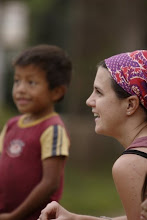
We live in a global society. No community or country can act as a island (even if the country is an island!). Between trade, immigration and diplomatic relations, we are all connected. Even though we are sometimes divided by ethnic, cultural, social and/or political differences, I do believe that we can create a better world for the next generation by working together rather than against each other. Whether you are Italian or Indian (like the woman and children in this photo), you can find common ground.
In my experience in India, I have been impressed by the power of international free trade to encourage widespread economic growth and development. I have seen the positive upside of outsourcing and globalization. While I recognize that fair play is necessary to ensure the success of trade, I have seen firsthand the beneficial impact it can have on the poor.

4) Equal Rights are Empowering.
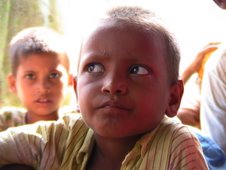
Women can play a critical role in economic development. However, we have to ensure that they are part of the process. This requires significant investment and energy in the short-run because women are not as experienced or educated as their male counterparts, especially in less advantaged populations. Organizations have to take a risk on these women to help them succeed in business. Drishtee has done a fantastic job involving women as entrepreneurs and I believe it will pay off for the organization in the long run. To increase female participation in the formal market economy, however, we also have to address the existing gender-related barriers. Laws are needed to protect equal rights and criminalize discrimination and domestic violence. Like this girl and boy, all children must have equitable education opportunities and child care issues must be considered.

5) You Gotta Have Hope.
I read an article this summer about a global survey that asked people what they thought about the future. I can’t remember the exact numbers but people in
Friday, 24 August 2007
Thanks
As I wrap up my time in India India 


Tuesday, 21 August 2007
Unintended Consequences of a Call Center
Thanks to the terrible traffic in Mumbai, I spent a lot of time with Iqbal, the driver for my friend. Originally from Pune, Iqbal is a Muslim who was born and raised in
Iqbal told me all about the Muslim community in Mumbai. He was incredibly open and we discussed veils and women’s rights as well as fundamentalism and terrorism. Proud of his religion but concerned about the extremists, Ikbal represented the modern Muslim Indian.
Still, I was most amazed with the story of Iqbal’s son, who works in a call center nearby. Though Iqbal has struggled financially throughout his life, he is comforted by the fact that his son has many more opportunities. His son speaks English fluently and has secured a high-paying position. Ikbal says that this job has changed his son’s life; he is committed to working hard to achieve success and is hopeful for the future. In addition, he has a Christian girlfriend whom he met at work. When I asked Iqbal if he was okay with his son’s girlfriend, he said that things had been different for his generation but his son helped him realize that they were happy. Which made Iqbal happy.
Of course, Iqbal and I both know that the call center job itself does not create this happiness in and of itself. Still, these jobs can have a positive impact on employees. They are paid well relative to the national average, receive excellent training and are likely to move up within their organizations if they work hard. They are also exposed to the broader world and are more invested in the future. In addition, young folks like Iqbal’s son are less likely to be influenced by extremism than disenfranchised Muslim youth who live in crowded, under-resourced slum communities where the offer of fundamentalism seems more enticing.
I am not naïve enough to believe that call centers can save the world. Still, Iqbal’s son provides a compelling portrait of the upside of globalization. Please remember him the next time you get frustrated with customer service. Don’t be mean to the representative, just insist on speaking to a supervisor!
Subscribe to:
Posts (Atom)